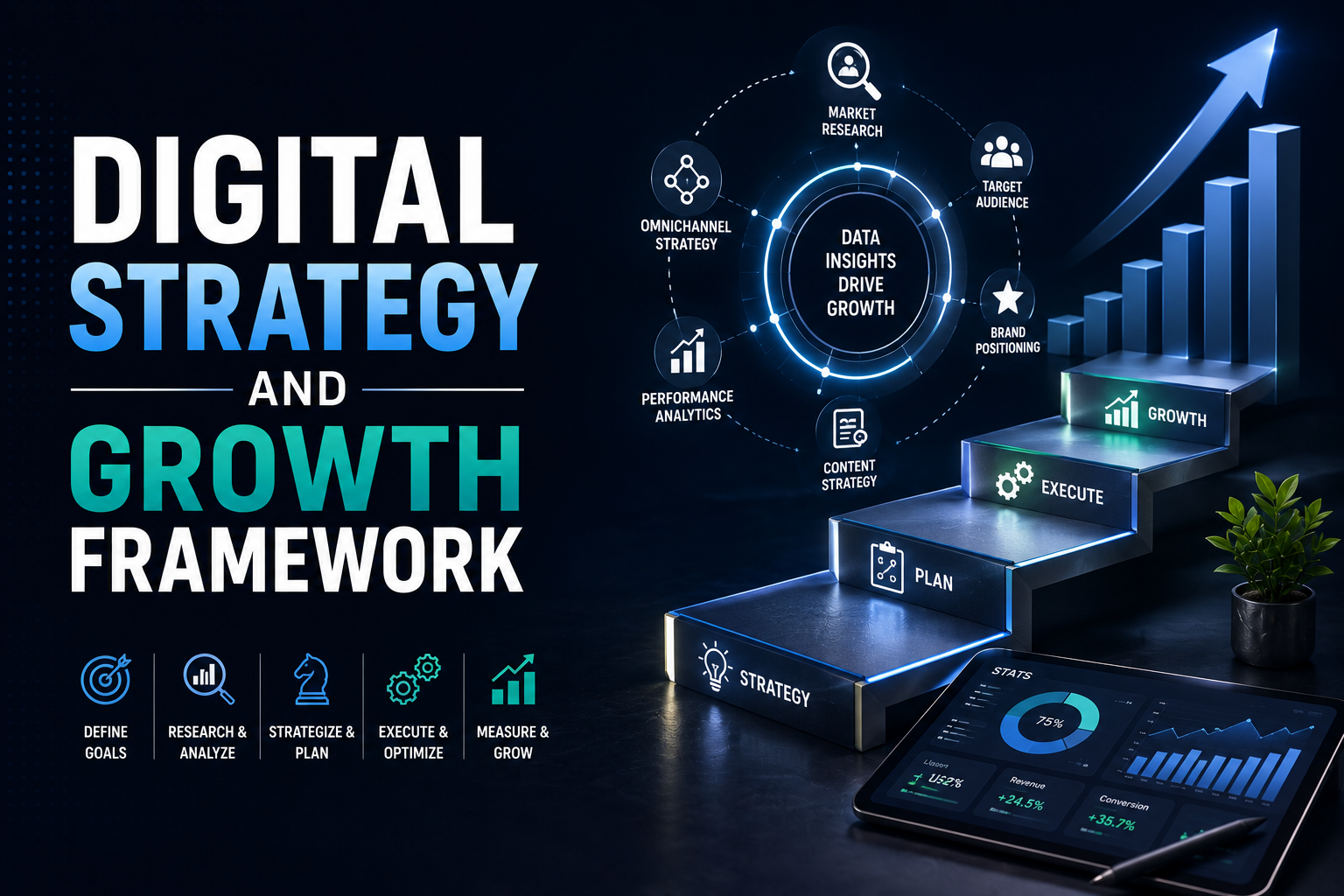
Spend doubled. Revenue didn't move. The dashboard was green the entire time.
This is the most common failure in digital marketing, and it almost never shows up as a red number. Everything looks healthy. Impressions up, clicks up, cost per click holding. Somewhere between all that motion and the bank account, the money quietly evaporates. A real digital strategy and growth framework exists to close that gap, and the gap is rarely where anyone's looking.
The problem usually isn't the ads. It's that nobody defined what the framework was supposed to produce before switching it on.
What Actually Tracks A Working Framework
Green dashboards lie because they measure activity, not outcome. Here's what a digital strategy and growth framework should be judged on instead, in order of how often it gets ignored:
- Contribution margin per channel, not ROAS. ROAS flatters channels that harvest demand you already had. Margin after fulfillment tells you which channel actually made money.
- Payback window. A customer who's profitable in month nine is a cash-flow problem disguised as a win, especially at scale.
- Incrementality. The hardest and most important number. If those conversions would have happened without the spend, the spend bought nothing but attribution credit.
- Blended CAC trend. Per-channel numbers hide overlap. The blended figure moving the wrong way is the early warning nobody wants to read.
Quick take: if the framework can't tell you which of the last hundred customers it would have won for free, it isn't measuring growth. It's measuring spend.
Running Multi-Regional Performance Ads
The instinct is to build one campaign that works everywhere. It works nowhere instead.
Running multi regional performance ads well means accepting that a market isn't a language setting. The creative that converts in one region can fall flat in another for reasons no translation fixes: different buying triggers, different objections, different levels of trust in the format itself. A video testimonial that builds credibility in one place reads as staged in another.
What actually separates regional performance from regional presence:
- Localize the offer, not just the copy. Price anchoring and payment norms differ market to market, and the offer is what converts.
- Rebuild the objection, don't retranslate it. The private hesitation a buyer carries changes by region. Name the local one.
- Read local signal windows. Peak intent times, seasonal rhythms, and even which day people buy shift geographically.
Quick take: a campaign that's merely translated is a campaign that's been made worse in a second language.
Scaling Digital Agency Operations Globally
Strategy fails at the operations layer more often than at the idea layer, and this is where.
Scaling digital agency operations globally exposes a split most teams never resolve: the tension between consistency and local fit. Centralize everything and every market gets a generic campaign that offends no one and converts no one. Decentralize everything and you get forty teams reinventing the same reporting, the same creative tests, the same mistakes, with no shared learning between them.
The structure that survives contact with reality sits between those poles. Central owns the framework: the metrics that matter, the testing method, the quality bar. Local owns the execution: the creative, the offer, the objection. The framework travels. The execution stays home. Teams that get this backward, standardizing the creative and improvising the measurement, produce a lot of activity and very little compounding.
Quick take: standardize how you decide, localize what you decide.
Executing Precision Brand Development Models
Performance marketing without brand is a bucket with a hole in it. Pour faster, lose faster.
Executing precision brand development models means treating brand as the thing that makes every performance dollar cheaper over time, not as a separate budget that competes with it. When a market already recognizes and trusts a name, the ads convert at a lower cost, because half the persuasion happened before anyone clicked. Skip the brand layer and every campaign starts from zero trust, forever, paying full price for attention it could have banked.
Picture two companies spending identically on ads. One invested in recognition for eighteen months first. The other went pure performance. Same spend today, and the first company's cost per acquisition runs a fraction of the second's, because its ads land on warm ground. The gap widens every quarter. That compounding is the entire argument for the brand layer, and it's invisible on a monthly dashboard, which is exactly why it gets cut.
Quick take: brand is what makes performance affordable next year.
Where This Leaves You
A digital strategy and growth framework isn't a set of campaigns. It's the decision layer above them: what to measure, what to localize, what to centralize, and what to build before the spend even starts.
Most brands install it backwards, buying media first and defining success later. Reverse that order, and the green dashboards start telling the truth.
For a framework built against real objectives rather than vanity metrics, start a conversation here.