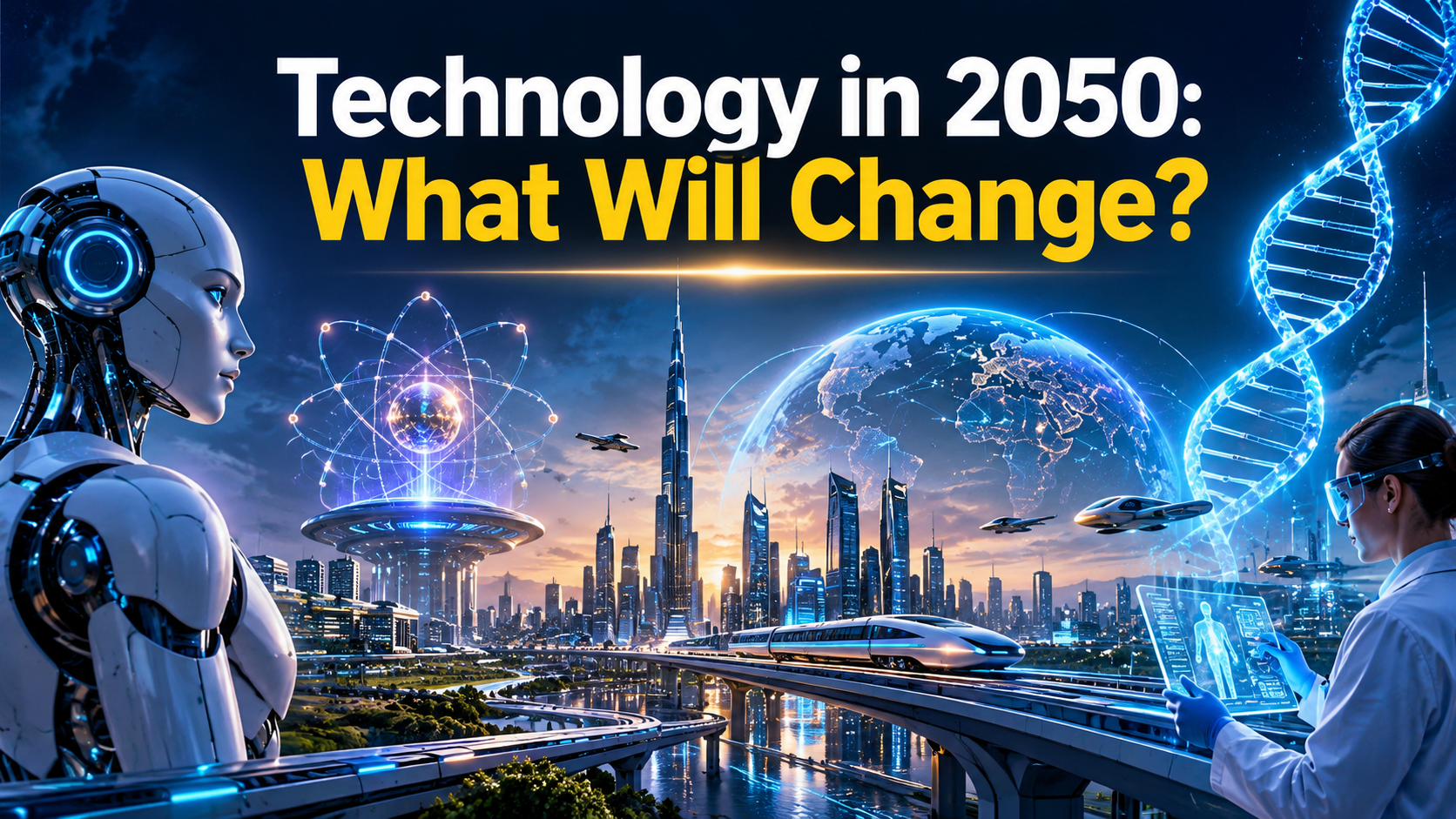
The world of 2050 will not simply be a more advanced version of today. It could be a world where artificial intelligence transforms decision-making, quantum computing changes scientific research, genetic engineering reshapes medicine, and technological leadership influences global power.
These changes are already developing. Their combined impact, however, remains one of the most important questions facing humanity.
Understanding the future requires looking beyond individual inventions and examining how different technologies could interact. Four major developments deserve particular attention.
1. Artificial Intelligence Will Transform How Humanity Works
Artificial intelligence is moving beyond answering questions and automating simple tasks. Advances in machine learning, generative AI, and autonomous systems are creating opportunities to transform research, healthcare, education, manufacturing, and business operations.
By 2050, AI could become deeply integrated into critical infrastructure and everyday decision-making.
Intelligent systems may help scientists accelerate discoveries, assist doctors with complex diagnoses, optimize industrial operations, and coordinate business processes across multiple industries.
However, greater intelligence will also introduce important questions about accountability, employment, privacy, and human control.
The future of AI will depend not only on what machines can accomplish but also on how responsibly societies choose to use them.
2. Quantum Computing Could Change Scientific Discovery
Traditional computers process information using bits, while quantum computers use quantum bits, or qubits, to perform specialized computational operations.
Although practical quantum computing still faces significant technical challenges, its potential applications include molecular simulation, materials science, optimization, and cryptography.
By 2050, advances in quantum hardware and error correction could make certain complex scientific problems more accessible.
One particularly important area is cybersecurity. Future quantum capabilities could threaten some widely used public-key encryption systems, making the transition toward post-quantum cryptography increasingly important.
Quantum computing will not replace conventional computers. Its significance will come from solving particular problems that are difficult for classical systems.
3. Genetic Engineering Could Reshape Human Health
Biotechnology is advancing our understanding of DNA, biological systems, and the mechanisms behind disease.
Gene-editing technologies, synthetic biology, and computational biology are creating new possibilities for medical research and treatment development.
By 2050, these fields could contribute to more personalized healthcare, improved disease detection, and treatments designed around individual biological characteristics.
Artificial intelligence may further accelerate this progress by helping researchers analyze genetic information and identify potential biological relationships.
But these developments also raise serious questions about genetic privacy, unequal access, inherited modifications, and the ethical boundaries of changing human biology.
Scientific progress must be accompanied by responsible governance and public discussion.
4. Technology Will Influence the Global Balance of Power
Technological leadership is increasingly connected to economic competitiveness, national security, and international influence.
Countries investing in artificial intelligence, semiconductor manufacturing, biotechnology, quantum research, and advanced infrastructure may gain significant strategic advantages.
By 2050, global influence could depend increasingly on the ability to develop, control, and responsibly deploy critical technologies.
However, technological progress will not be distributed equally.
Access to research infrastructure, investment, skilled professionals, and computing resources could determine which countries participate in shaping the next technological era.
International cooperation will therefore remain important in ensuring that emerging technologies benefit societies beyond a small number of powerful economies.
Why Understanding the World in 2050 Matters Today
The future is not something humanity simply waits to experience. Decisions made today influence which technologies develop, who benefits from them, and how societies respond to their consequences.
Artificial intelligence, quantum computing, genetic engineering, and changing geopolitical relationships should not be examined as isolated developments. Their convergence could create opportunities and challenges that are difficult to understand through a single technological perspective.
This is the thinking behind World in 2050, a book by Salman Waria that explores these four interconnected forces and their potential influence on the next era of humanity.
Explore World in 2050 by Salman Waria to discover the ideas, technological developments, and future scenarios examined in the book.
Final Thoughts
The world in 2050 will be shaped by the decisions, discoveries, and innovations taking place today. Understanding these developments is essential for entrepreneurs, technology leaders, researchers, and anyone interested in the future of civilisation.
The most important question is not simply which technology will become the most powerful. It is how humanity will use these technologies to shape the world it wants to live in.
Through his work on technology, entrepreneurship, and future innovation, Salman Waria explores the possibilities emerging at the intersection of these fields.
Because the future belongs not only to those who predict change, but also to those who understand it and help build what comes next.