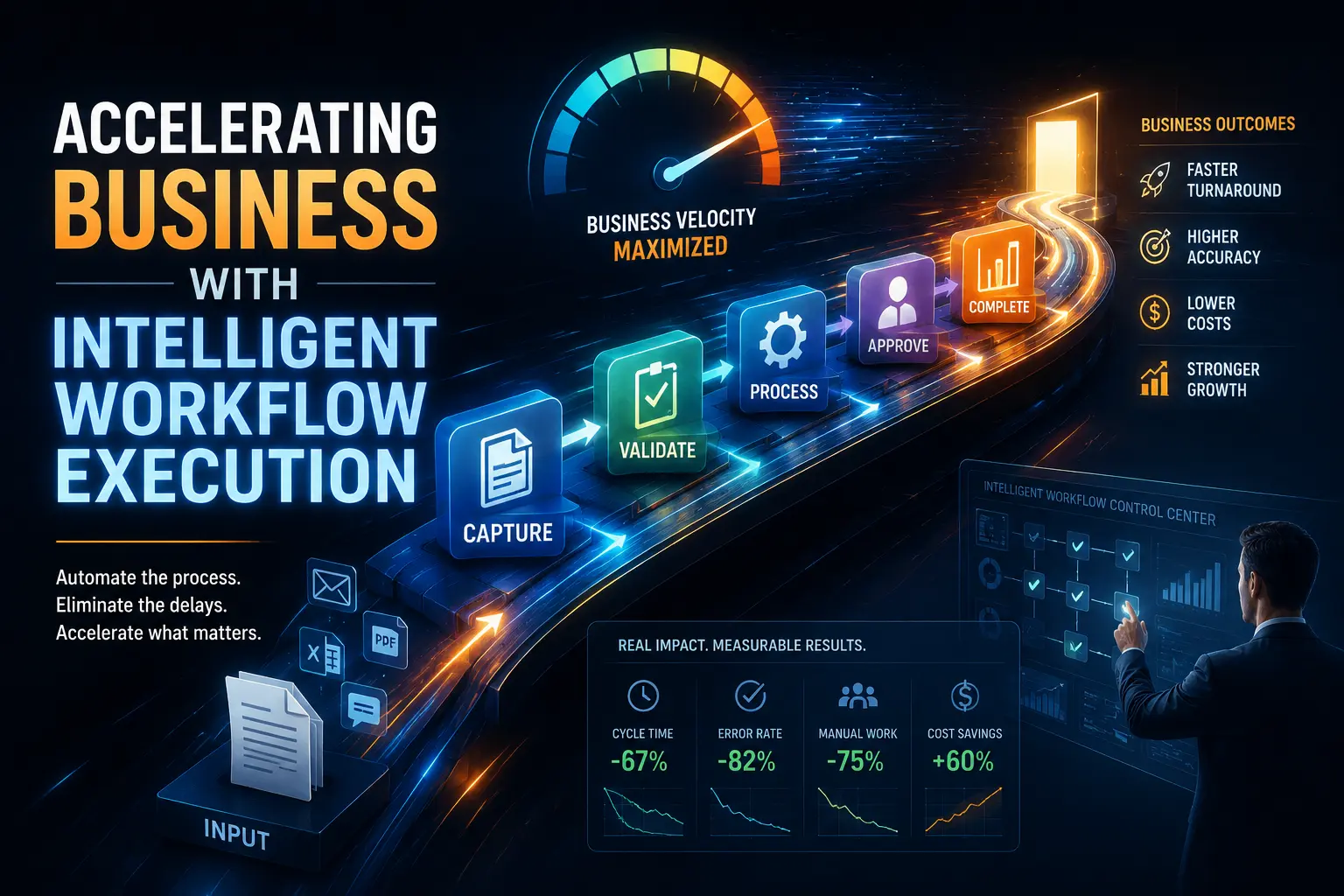
One invoice approval, timed end to end: four days, eleven hours.
The actual human decision-making inside that window took about nine minutes. Everything else was the invoice sitting in a queue, waiting for someone to notice it existed.
Nine minutes of work. Four days of waiting.
That ratio is the entire argument for intelligent workflow execution, and it surfaces in nearly every ops audit that bothers to measure the two numbers separately. Most don't. Which is why the ratio survives.
The useful exercise is following one ticket all the way through, watching where the time actually goes.
The Four Numbers On The Scoreboard
Before the teardown, the measurement has to be right. Most teams track the wrong things and then celebrate.
- Cycle time, not handle time. Handle time measures the nine minutes. Cycle time measures the four days.
- Touch count. Every human who opens the ticket represents a queue.
- Rework rate. Automation that's fast and wrong is a machine for generating cleanup.
- Escalation ratio. The trend matters more than the number.
Pointer: a dashboard showing handle time falling while cycle time holds flat means the automation is making individuals faster inside a system that doesn't care.
Optimizing Domain Focused Conversational AI
Hour zero. The ticket arrives. The customer writes: "Charge on the 14th doesn't match my plan."
A general bot reads that and offers a password reset. It pattern-matched "doesn't match" and went hunting. This happens in production more often than vendors care to mention.
Optimizing domain-focused conversational AI means the model already knows what a plan is at that specific company, what a mid-cycle proration looks like, and that the 14th is the billing anchor date. That knowledge isn't prompting. It's grounding in the system of record.
Pointers for this layer:
- Billing schemas beat help articles. Help articles describe. Schemas decide.
- Scope stays capped. Nine intents handled brilliantly beats ninety fumbled.
- A clean exit is a feature. "Routing this to Sarah" is a good answer. Improvisation isn't.
- Every guess gets logged. That log becomes the roadmap.
Narrow beats broad. Consistently, in production, without much argument left about it.
Maximizing Contextual Accuracy in Automation
Hour two. This is where most deployments quietly die.
The system pulls the customer record. Active plan, payment on the 14th, match. Confident answer: the charge is correct.
Wrong. The customer upgraded on the 9th, the proration hit separately, and the record the bot queried doesn't join to the billing events table. The data was accurate. The context wasn't.
Maximizing contextual accuracy in automation is a question of joins, not intelligence. The model performed fine. The retrieval was blind on one side.
Pointers:
- Every table the workflow touches gets mapped, then compared against the ones it should touch. The gap is the bug.
- Confidence scores mean nothing uncalibrated. A model 94% sure and wrong is worse than one that shrugs.
- Ugly edge cases come first. Clean cases teach nothing.
- Context sources get versioned. When accuracy drops, the diff answers why.
One small practice saves hours: logging what the system retrieved, not only what it answered. Roughly half of all "the AI is broken" reports turn out to be retrieval rather than reasoning.
Reducing Corporate Task Latency
Back to the stopwatch. Day two, hour nine. The ticket sits in a review queue.
Nobody is working on it. Nobody is blocked by it. It ages, because a rule says a human confirms anything above $500, and that human is in a different timezone with 61 unread items.
Reducing corporate task latency means attacking the gaps between the work rather than the work itself. Few teams do. They optimize the nine minutes instead, because the nine minutes are visible and the four days are nobody's line item.
Where the days hide:
- Approval thresholds set years ago, never revisited against current volume
- Queue handoffs where ownership resets and the clock restarts
- Batch jobs running nightly for reasons nobody currently employed can explain
- Notification gaps. The work was ready at 4 pm. Someone found out at 9 am.
Pointer: charting waiting time separately from working time across the last hundred completed tickets usually produces an embarrassing picture. It also produces the cheapest roadmap available anywhere.
When Not To Automate This
A workflow nobody can describe on a whiteboard in five minutes isn't ready. Neither is a process that changes monthly. Neither is anything carrying a rework rate above 15%, because automating that ships the mess faster and calls it progress.
Bad process plus automation equals bad process at scale. That's not a saying. It's a Q3 postmortem.
Where The Ticket Ended Up
Rebuilt, the same invoice approval runs in roughly forty minutes. Not because anyone works faster. Because it stopped waiting.
The nine minutes are still nine minutes. Intelligent workflow execution killed the other four days, and that's where the money always was. What that looks like assembled into an operating stack rather than described in a blog post: salmanwaria.com.